
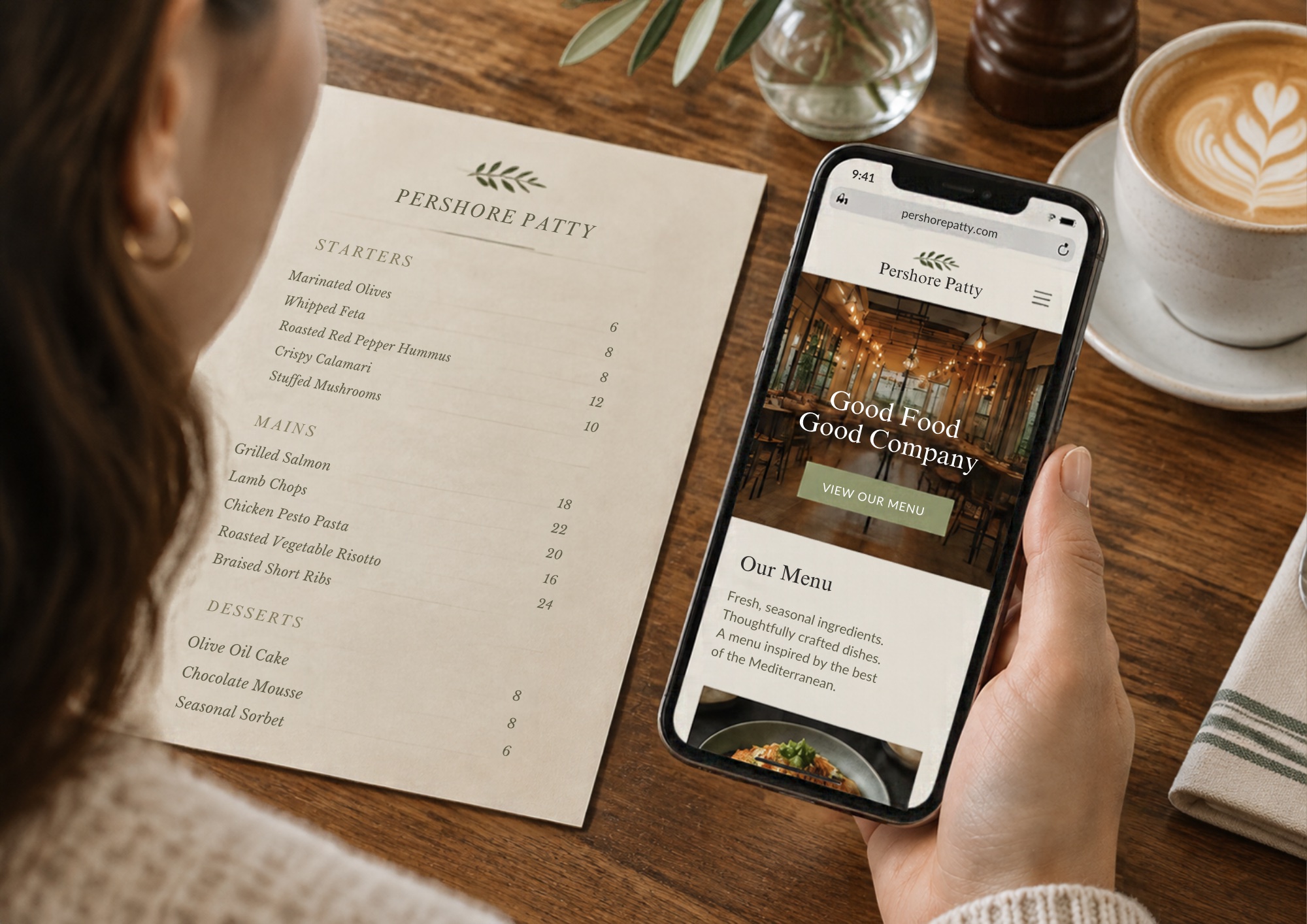
I recently asked my Facebook followers what frustrates them most when visiting restaurant websites. Their responses raised some interesting points about menus, prices, booking systems and the small details that can influence whether somebody decides to visit.
I spend a considerable amount of time looking at restaurant websites, whether I’m researching somewhere new for Pershore Patty, checking a menu ahead of a visit or simply deciding where we’d like to go for lunch or dinner.
It’s become such a familiar part of choosing where to eat that I sometimes wonder how much thought restaurants give to the experience customers have before they even arrive.
Think about what usually happens when you hear about somewhere new. Perhaps a friend has recommended it, you’ve spotted a photograph on Instagram or you’ve read something that catches your interest. You search for the restaurant, visit its website and start looking for the information that will help you decide whether to book.
You probably want to see what sort of food it serves, how much it costs, where it’s located and whether there’s a table available. None of that seems particularly complicated, yet I’ve come across plenty of websites where finding even the most basic information takes far longer than it should.
It made me curious about whether other people experience the same frustrations, so I asked my Pershore Patty Facebook followers a simple question: What makes you leave a restaurant website?
The responses were interesting, particularly because so many people mentioned similar problems. This wasn’t a formal survey, and the people who commented aren’t necessarily representative of every restaurant customer, but their experiences offer a useful perspective on what can make choosing somewhere to eat unnecessarily difficult.
Menus, Menus and More Menus
If there was one subject that came up repeatedly, it was the difficulty of finding an accurate menu.
Several people said they were frustrated when restaurants didn’t publish their menus online at all, while others mentioned menus without prices, outdated information and sample menus that gave very little indication of what was actually being served.
Karen Powell mentioned the frustration of finding no menu, a sample menu or one that was two seasons out of date. Laura Haines-Gill made a similar point, explaining that she wants to know what’s available before arriving, particularly when the menu presented at the restaurant turns out to be completely different from the one advertised online.
I can understand both sides of this. Restaurants that work with seasonal ingredients often need flexibility, and I wouldn’t expect a kitchen to guarantee that every dish will be available weeks in advance. In fact, I quite like the idea of menus changing to reflect what’s fresh and available, rather than serving exactly the same dishes throughout the year.
However, there’s a difference between a restaurant explaining that its menu changes regularly and providing so little information that customers have no real idea what to expect.
Even if a venue can’t guarantee individual dishes, an example of its current cooking style, typical menu choices and indicative prices would give potential customers something useful to work with.
It’s also worth remembering that people often look at menus for reasons beyond deciding what they fancy eating. They might be checking whether there’s enough choice for their family, whether the restaurant caters for particular preferences or whether the prices are suitable for the occasion.
The menu is often one of the first things people look for, so making it difficult to find seems an unnecessary obstacle.
Why Are Prices Sometimes So Difficult to Find?
Another recurring frustration was the absence of prices.
For many customers, knowing roughly what a meal will cost is an important part of deciding where to eat. That doesn’t necessarily mean they’re looking for the cheapest option, but most people want to understand what they’re likely to spend before making a reservation.
One comment that particularly caught my attention came from Emma Thomas, who said that when a restaurant doesn’t display its prices, she tends to assume she can’t afford it.
I thought that was an interesting observation because it highlights how easily a business might create the wrong impression. A restaurant could be offering perfectly reasonable prices, but if customers can’t see them, they may assume it’s considerably more expensive than it actually is.
There’s also the question of occasion. What somebody considers reasonable for a quick weekday lunch might be very different from what they’re happy to spend on a birthday, anniversary or another special evening out.
Personally, I like knowing what sort of experience and price point to expect before visiting somewhere. It helps me decide whether it’s the right choice for that particular occasion, and I don’t think restaurants have much to lose by making that information available.
Making a Reservation Should Be Straightforward
Booking systems were another subject that generated quite a bit of discussion.
Some people mentioned restaurants that only accept bookings by telephone or email, while others were frustrated by booking links that didn’t work or websites without any obvious way to reserve a table.
Jan Morris explained that she prefers the convenience of online booking, particularly because restaurants don’t always answer the telephone when customers call.
Having spent plenty of time trying to arrange restaurant visits myself, I can certainly relate to that. There have been occasions when I’ve wanted to book somewhere, couldn’t get through on the telephone and ended up looking at another option instead.
Of course, online booking isn’t necessarily the right solution for every restaurant. Smaller venues may prefer to manage reservations personally, and some businesses have perfectly good reasons for using a more traditional approach.
The important thing is that whichever system a restaurant chooses, customers should understand how it works and be able to use it without unnecessary difficulty.
If bookings are taken by email, it helps to explain when customers can expect a response. If reservations are handled over the telephone, make the number easy to find and provide an alternative when staff aren’t available to answer.
For restaurants offering online booking, it’s worth regularly checking that the system works properly, particularly when customers are following links from Instagram, Facebook or Google.
A customer who’s reached the point of trying to make a reservation has already shown a fairly strong interest in visiting. Making that final step difficult seems a missed opportunity.
Booking Deposits Divided Opinion
I wasn’t surprised to see booking deposits and card guarantees mentioned, as they’re something people often have strong feelings about.
Nathan Callis said he understood why deposits might be required for larger groups but was less comfortable with the idea for smaller bookings. Rich Martin also mentioned being asked to provide card details as something that would put him off.
I can understand why customers might hesitate, particularly if they’re visiting somewhere for the first time and aren’t clear about the restaurant’s cancellation policy.
However, having spoken to hospitality businesses about the problems caused by no-shows and last-minute cancellations, I can also see why some restaurants have introduced these measures.
When a table is booked and the guests don’t arrive, the business may have turned away other customers, arranged staffing and prepared ingredients for covers that never materialise. For smaller restaurants in particular, the financial impact can be significant.
I don’t think there’s a single approach that will suit every venue or every customer, but the comments did reinforce the importance of explaining booking policies clearly.
There’s a difference between paying a deposit and providing card details as a guarantee, yet that distinction isn’t always obvious when making a reservation. Customers should be able to see whether money will be taken immediately, what happens if they cancel and how much notice they’re expected to give.
Even if somebody doesn’t particularly like a restaurant’s policy, they’re in a much better position to make an informed decision when the terms are explained properly.
Dietary Information and Children’s Menus Matter
Several people raised concerns about dietary requirements, allergen information and the availability of children’s menus.
Jayne Glass mentioned the absence of allergen information, while Loretta RB highlighted difficulties finding dairy-free options, allergen details and children’s menus. Ruth Jodie Caldicott also raised the lack of vegetarian choices.
Zara Marie made a useful point about children’s menus, explaining that although her own children aren’t particularly fussy, it’s helpful to know what’s available and how much it costs before visiting. Children’s menu prices can vary considerably, and families may want to check that there’s something suitable for everyone.
For people with specific dietary requirements, being able to find reliable information before booking can be particularly important.
Restaurants don’t necessarily need to publish every detail of their allergen procedures online, and customers with allergies should always be encouraged to discuss their requirements directly with the team. However, it should be clear how to obtain accurate information and whether the kitchen can potentially accommodate particular needs.
Even something as simple as making vegetarian and vegan dishes easy to identify, publishing a children’s menu or providing a clear contact point for allergen enquiries can help customers decide whether a venue is suitable.
It’s worth remembering that the person researching a restaurant might be booking for a whole group rather than just themselves. They may need to consider several different preferences and requirements before choosing somewhere everyone can enjoy.
The Problem with PDF Menus
I was particularly interested in how many people mentioned PDF menus, because they’re something I regularly encounter when researching restaurants.
I can understand why businesses use them. A PDF allows a restaurant to upload a menu that looks exactly like its printed version, without having to redesign the website every time a dish changes.
Unfortunately, what looks beautiful on an A4 menu doesn’t always work particularly well on a mobile phone.
Michelle Scott mentioned the frustration of having to download small PDFs that are difficult to read, while Emma Thomas described needing a magnifying glass to see the menu properly.
I’ve experienced this myself, particularly with menus that have been designed for print using small fonts, multiple columns or elaborate layouts. You end up enlarging the document and moving backwards and forwards across the screen just to read the dishes and prices.
It’s not necessarily enough to have a menu available online if customers struggle to use it.
A menu presented directly on the website, with readable text that adjusts to different screen sizes, is often much easier to navigate. Restaurants can still offer a downloadable PDF if they want to, but it doesn’t need to be the only option.
With so many people researching restaurants on their phones, I think this is one of those practical details that’s worth reviewing.
Can Customers Actually Find You?
Several responses highlighted the importance of clear contact information, opening hours and location details.
David James Little mentioned websites where addresses and contact details were difficult to find, alongside unnecessary content and photography that didn’t help him make a decision.
Samantha Fenoulhet raised similar frustrations, including broken links from social media, inaccessible menus and opening hours that weren’t clearly displayed.
These might sound like small details, but they’re often exactly what somebody is looking for when visiting a restaurant website.
If you’re planning lunch somewhere unfamiliar, you probably want to know where it is, whether there’s parking nearby and what time the kitchen serves food. If you’re hoping to book dinner, you’ll want to find contact details or a reservation system without having to search through several pages.
Professional photography, thoughtful branding and an attractive website design can all help create a positive impression, but they shouldn’t make the practical information more difficult to find.
I also think it’s worth checking the links restaurants share across their social media profiles. I’ve occasionally followed a link expecting to reach a menu or booking page, only to find it takes me somewhere completely different or no longer works.
Those links are often the connection between somebody discovering a restaurant on social media and actually making a reservation, so keeping them up to date is particularly important.
Is a Facebook Page Enough?
Another point raised was the frustration of restaurants that don’t have a dedicated website and rely entirely on a Facebook page, particularly when that page hasn’t been updated recently.
Jan Morris mentioned this as something she finds particularly unhelpful.
Social media is undoubtedly useful for hospitality businesses, and I spend a great deal of time using it myself to discover openings, new menus, special events and other developments across the region.
However, social media pages aren’t always particularly easy to navigate when you’re looking for specific information.
A menu might have been shared several weeks earlier, opening hours may have changed since they were last updated, and important details can become buried among photographs, announcements and other posts.
There’s also the fact that not everybody uses Facebook or Instagram, so relying exclusively on social media can make information less accessible to some potential customers.
I don’t think every independent restaurant needs an expensive or complicated website. A relatively simple, well-maintained site that clearly explains what the business offers, where it is, when it’s open and how to book can be extremely useful.
It’s often better to have something straightforward that works properly than an elaborate website that’s rarely updated.
Does a Website Need to Be Beautiful, or Just Useful?
One follower also mentioned AI-designed websites, which made me think about how much easier it has become for businesses to create an impressive-looking online presence.
There are now plenty of tools available to help businesses build websites, create imagery and produce marketing content without necessarily needing specialist design experience.
That can be helpful, particularly for independent businesses working with limited budgets. However, a website still needs to reflect the restaurant accurately and provide information people can trust.
I enjoy looking at good restaurant photography, and I think photographs can play an important part in helping customers understand the food, atmosphere and overall experience.
There’s little point in having a beautifully designed website if visitors can’t find the menu, prices or booking information.
The two things should work together. Good photography and thoughtful design can encourage people to explore, while clear, practical information helps them decide whether to visit.
What Can Restaurants Take From These Comments?
The discussion on my Facebook page wasn’t intended as a piece of formal consumer research. It was simply a question I was curious about, and the responses came from people who chose to share their own experiences and frustrations.
It’s important to keep that in perspective. Not everyone will feel the same way about booking deposits, PDF menus or the amount of information a restaurant should publish online.
However, I found it interesting that so many comments came back to the same basic expectations.
People want to know what’s on the menu, how much it costs, where the restaurant is, when it’s open and how to make a reservation. They also want confidence that the information they’re looking at is reasonably current and reflects what they’ll experience when they arrive.
None of those requirements seems particularly unreasonable, and many could be addressed without making significant changes to a website.
For anyone running a hospitality business, I’d suggest spending a few minutes looking at your website from the perspective of somebody who’s never visited before.
Try opening it on your phone and finding the menu, checking the prices, looking up the opening hours and making a reservation.
Better still, ask somebody who isn’t familiar with the business to do the same and see whether they encounter any difficulties.
It’s quite easy to overlook these things when you know your own business inside out. You already know where everything is, how the booking system works and what the menu looks like, but a first-time customer doesn’t have that knowledge.
The Customer Experience Begins Before They Arrive
We often talk about the importance of first impressions in hospitality, particularly the welcome somebody receives when they walk through the door.
But for many people, their first experience of a restaurant happens long before that. It might begin with an Instagram post, a recommendation from a friend or a Google search that leads them to the website.
What happens next can influence whether they decide to book.
I don’t think restaurants necessarily need increasingly elaborate websites or expensive marketing campaigns to make a good impression online. In many cases, being clear, accurate and easy to deal with is just as valuable.
The feedback from my Facebook followers has certainly reinforced that point for me. While people may be attracted to a restaurant because of its food, reputation or photographs, they still need enough practical information to make a decision.
A restaurant website doesn’t just need to make somewhere look appealing. It needs to help people take the next step towards visiting.
Given how competitive the hospitality industry can be, making that process as straightforward as possible seems a sensible place to start.
Thank you to everyone who contributed to the original discussion on the Pershore Patty Facebook page. The comments featured here reflect individual experiences and opinions rather than the results of a representative customer survey.